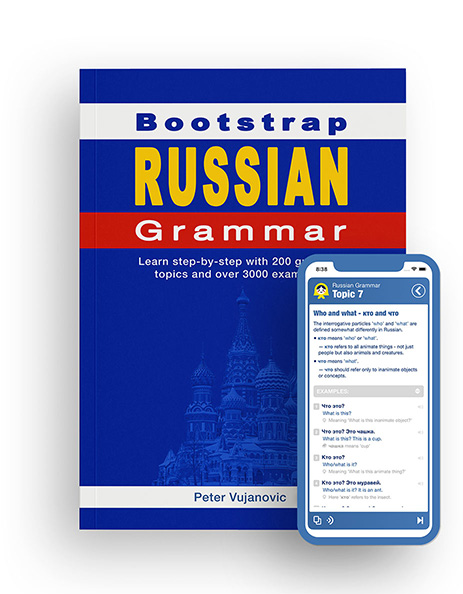
 535 pages with 200 topics
Learn Russian Grammar Step‑by‑step
Bootstrap
Russian
Grammar
A 535-page book and accompanying mobile app.
● Step-by-step introduction to Russian grammar in 200 topics.
● Over 3,000 annotated examples.
● High-quality audio pronunciations via the app.
● Targeted exercises to help learning and retention.

‘A new way to learn Russian Grammar’
Bootstrap Russian Grammar is a new way to learn Russian grammar. Starting from the beginning, the idea is to progress in small self-contained steps (called ‘topics’). Each topic builds on the last, by incrementally adding new grammatical patterns, new vocabulary and lots of useful examples.
In total there are 200 grammar topics and over 3000 example phrases.
Each topic includes a thorough explanation of the grammar and then lots of examples that illustrate the grammar. Each example includes an English translation, as well as notes highlighting how each example illustrates that topic's grammar, as well as the meanings of new Russian words.
The companion mobile application is now available also called "Bootstrap Russian Grammar". The app contains all the content contained in this book - including 200 grammar topics and over 3000 example phrases. And in addition, there is high quality Russian native-speaker audio for every example. More details here.

“Not your typical Russian grammar app”
‘At the time of writing I have 2060 consecutive days on Duolingo. During that time I’ve appreciated Duo for the vocabulary but found it very difficult to learn grammar. I’ve got a couple of grammar books (that I don’t have the time to properly study) and I’ve tried several grammar apps (that are characteristically poorly written, poorly explained and generally very unhelpful). I’ve learned more Russian grammar from this app in three days than I have in the past five years. If you’re serious about understanding Russian, this is the best £25 you’ll spend.’
Review by user JezDavis – Aug 26, 2023
“I think it is fantastic!”
‘I recently purchased a copy of your Bootstrap Russian Grammar and just want to let you know that I think it is fantastic! I have actually been studying the language for years but have only recently had time to spend a lot of time on it and your book is invaluable. The rules are stated concisely and clearly and the examples are a marvellous help. Comparative Adjectives, for example, have always been a bit of a minefield but with the aid of your book I am finally getting to grips with them. I could go on with other examples but won't waste your time. Suffice to say I am delighted with my purchase and thank you very much to you and your team. I can't attach a gold star but the thought is there!’
Review by user Liz Calvert – Sep 25, 2024
Take a look inside the book
Drag or tap the page corners to flip through sample pages of the book.
All 200 topics
The book and the app follow the same 200 topics, in this order. Tap a section to see every topic in it.
Topics 1–9 First sentences‘To be’, pronouns, это, questions and negation, ты and вы, gender
- The verb 'to be'
- Personal pronouns
- Это : this, that, it
- Simple negation
- Asking and answering questions
- Formality in Russian: вы and ты
- Who and what – кто and что
- Gender and adjectives
- The conjunctions и, но and а
Topics 10–26 Nouns and adjectivesThe nominative case, plurals, possessives, comparatives and your first verb
- Plurals
- Plurals – exceptions and irregulars
- Demonstrative Pronouns – this, that, these and those
- Soft adjectives
- Adjectives – attributive or predicative
- The Nominative Case
- Plural adjectives
- Possessive pronouns
- Whose? – чей?
- Predicative comparative adjectives
- Comparisons with чем
- Irregular predicative comparative adjectives
- Attributive comparative adjectives
- One-word attributive comparative adjectives
- The verb делать (to do) in the Present Tense
- Adverbs of manner
- Why and because – почему & потому что
Topics 27–44 The prepositional caseWhere things are and what they’re about (в, на, о), plus everyday verbs
- Prepositional Case
- Prepositional Case – Plural
- Prepositional Case with на and дом
- The verb есть – presence or existence
- Demonstrative pronouns in the prepositional case
- The verb говорить – to talk; and the preposition о
- The verb писать – to write
- Questions in the prepositional case
- Personal pronouns in the prepositional case
- Adjectives in the prepositional case
- The verb думать – to think
- Possessive pronouns in the prepositional case
- Reflexive possessive pronouns in the prepositional case
- The verb жить – to live, to reside
- The Superlative using самый
- The conjunctions 'or' and 'either'
- Common irregular plurals
- The verbs смотреть and видеть
Topics 45–65 The accusative case and the past tenseDirect objects, wanting and understanding, days of the week, который
- The Accusative Case – Singular
- Accusative questions
- The Accusative Case – Plural
- The verb хотеть
- Adjectives in the Accusative Case
- Interrogative pronoun какой – which, what kind of
- The days of the week
- The verb понимать – to understand
- The accusative case of personal pronouns
- The conjunction а
- Short-form adjectives
- The short form adjectives велик and мал
- Resembles, looks like – похож на
- Possessive pronouns in the accusative
- More Russian verbs
- Negative pronouns – никто and ничто
- The Past Tense – быть
- Irregular past tenses: есть and сесть
- Adverbs of time
- Again – снова, ещё раз & опять
- Which, who and that – который
Topics 66–88 The genitive casePossession and absence, prepositions, quantities, numbers and months
- The Genitive Case and Ownership
- The Genitive Case – Relation to or part of the whole
- The Genitive Case – Possession
- The Genitive Case – Pronouns
- The Genitive Case – Denying possession with нет
- Presence and absence – 'there is' and 'there isn't'
- Some and the Partitive Genitive
- The verb стоять – to stand
- Prepositions that take the Genitive
- More prepositions that take the Genitive
- Yet more prepositions that take the Genitive
- Months – Месяцы года
- Spans of time
- The Genitive case – Plurals
- How many? Or how much? сколько
- The Genitive Case – Quantity words
- The Genitive Case – Possessive pronouns
- Nobody and nothing – никто and ничто
- The Genitive – Adjectives
- The Genitive – Demonstrative pronouns
- Comparisons using the Genitive
- Numbers and the Genitive Case
- Color, size and length with the Genitive Case
Topics 89–99 Verb aspect and verbs of motionPerfective and imperfective, мочь and уметь, идти and пойти, to and from
- Introducing verb aspects: говорить / сказать
- The verb мочь – to be able to
- Ability or know how – мочь & уметь
- As a consequence of – из-за
- Genitive and names of people
- Then – затем, потом & тогда
- The verb идти
- Prepositions of movement – в and из
- The verb aspect pair идти / пойти
- To where and from where
- More accusative movement prepositions
Topics 100–112 Conjugation and numbersSuch, same and different, the two verb conjugations, declining numbers
- Such, such like, such kind – такой
- The same as, similar – такой же
- The same thing – тот же
- Another and different – другой & разный
- Verb Conjugations: Type I
- Verb Conjugations: Type II
- Verb Conjugations: Consonant mutation
- Declension of один (the number one)
- Declension of два (the number two)
- Declension of три (the number three)
- Declension of the numbers 5 to 20 and 30
- Declension of семь (the number seven)
- Just and its derivatives
Topics 113–127 The imperative and linking wordsCommands and ‘let’s’, ходить and ездить, because, so and in order to
- The Imperative – Part 1
- The Imperative – Part 2
- The Imperative: Irregular verbs
- The Imperatives давайте and смотрите
- The first person imperative – Let's
- The multidirectional verb ходить
- Movement by transport – uni-directional: ехать/поехать
- Movement by transport – multi-directional: ездить/поездить
- Verbs of motion and prefixes: приходить and прийти
- Nowhere
- For what purpose? So as to – зачем & чтобы
- Due to, since, because of – поскольку & так как
- So and therefore – так что & поэтому
- The third-person imperatives пусть and пускай
- When – the difference between когда & пока
Topics 128–133 Reflexive verbs-ся verbs, находиться, emphasis with же, to carry and to bring
- Reflexive Verbs – Introduction
- находиться / найтись
- Reflexive Verbs – Lots of new verbs
- Emphasis with the particle же
- Catenative verbs
- The verb 'to carry' and 'to bring'
Topics 134–151 The dative caseTo and for someone, нравиться, feelings, -то and -нибудь, можно and нельзя
- The Dative Case
- Verbs that take the Dative
- Personal pronouns in the dative case
- Expressing emotional or physical states
- The prepositions к and по with the dative
- Ready for – к + dative
- Dative Case Plurals
- The dative and demonstrative pronouns
- To like: нравиться and the Dative Case
- Three ways 'to ask'
- Reflexive verbs in the past tense – introduction
- More past tense reflexive verbs
- Possessive pronouns in the dative case
- Adjectives in the dative case
- The preposition по and the dative case
- The interrogative particle ли
- Something and anything: -то and -нибудь
- Possibility and permission with можно and нельзя
Topics 152–162 Time, age and obligationOrdinal numbers, telling the time, durations, должен, надо and нужно
- Ordinal Numbers
- Telling the time
- Telling the time – advanced
- At a particular time
- More prepositions of time
- Talking about durations of time
- Talking about age
- Obligation with должен and обязан
- Saying 'need to' with надо and нужно
- It seems – кажется
- More uses of the Dative Case
Topics 163–172 The instrumental caseWith and by, describing a state, seasons and times of day
- The Instrumental Case
- Personal pronouns in the Instrumental case
- You with someone
- Expressing a state with the instrumental case
- The Instrumental Case – Plurals
- The Instrumental Case – Adjectives
- Possessive pronouns in the instrumental case
- The Instrumental Case – Demonstrative Pronouns
- Short adjectives that take the instrumental
- Seasons and Times of the Day
Topics 173–186 The future tensePerfective and imperfective future, becoming (стать), себя, весь, dates
- Future tense – perfective future
- The future tense of быть (to be)
- Instrumental case with быть and стать
- Ordinal numbers as adjectives and adverbs
- Future tense – imperfective future
- The reflexive personal pronoun себя
- Verbs that take the Instrumental case
- Prepositions that take the instrumental case
- Imperative with reflexive verbs
- What or which – какой (continued)
- All, the whole and everyone – весь
- The relative pronoun который – continued
- Dates – days and months
- Both – оба & обе
Topics 187–200 Conditionals and advanced grammarPrefixed verbs of motion, если and если бы, бы + ни, the passive voice
- Prefixing verbs of motion
- Conditional with если
- The Conditional with если бы
- Requests, desires and advice with бы
- To get used to – привыкать / привыкнуть
- It's time – пора
- May be, it may be that – может быть
- The Prefix 'по'
- Conjunctions: before, just before, after and since
- Irregular verbs: to grow and to die
- Putting or placing objects
- Conjugation of -ыть verbs
- Whatever, whoever: бы + ни
- Passive Voice
What will you learn from this book?
-
 You will get a thorough grounding in Russian grammar — starting from the very basics we cover all 6 Russian grammatical cases and much much more.
-
You will be exposed to thousands of colloquial Russian phrases — Bootstrap Russian teaches Russian grammar by providing lots of example phrases to illustrate each topic.
-
You will memorise thousands of Russian words — the method is to bootstrap from zero. So every new Russian word you encounter is defined and is in context.
-
You will learn to pronounce Russian — Russian pronunciation is challenging. The companion mobile app provides high quality native-speaker audio pronunciation of every single example phrase.
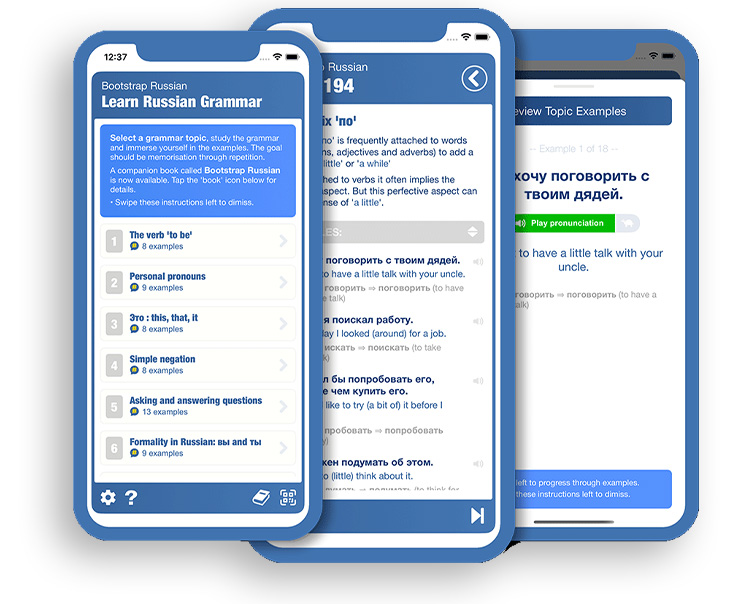
The companion mobile app
All the content in the book PLUS audio!
- All 200 grammar topics - step-by-step
- All 3,000 plus example phrases
- Annotated examples and English translations
- AND high quality native-speaker audio pronunciations for each and every example.
- In-app QR code synchronization with the book
- NEW! Hands-off voice-controlled example phrases review
- Available for both iPhone/iPad and Android.
A word from the book's Editor